It's for times like this that we have the phrase EEKINGTON SQUEAKINGTON!
It arrived today, and once I've finished Villette, there will be no stopping me...
One of the books which snuck into my novella weekend was in fact (gasp!) not a novella, but a screenplay - I read The Hours by David Hare.
 I'm a bit of an addict of The Hours. It's how I first encountered Virginia Woolf. I've seen the film maybe eight or nine times; I have two versions of the soundtrack (one normal; one piano version); I have the piano music. Naturally I've read Michael Cunningham's brilliant novel - twice, in fact. So it was only logical that (at least until they invent some sort of The Hours computer game - fall out of a window for ten points! Throw a cake in the bin for 20!) I should read David Hare's screenplay.
Do you read screenplays? We talked about reading plays a while ago, and quite a few of us did, but not that often. I love reading plays, and although I haven't read many recently, I devoured all of A.A. Milne's many plays back in 2002/3. The Hours, on the other hand, is the first screenplay I've ever read.
I suppose there are a few reasons for this. Chief amongst them is that not many are published. With most films there will be a team of writers, I suppose, and it is only the aficionado who'll have a clue who wrote the screenplay. Think through your favourite films... do you know the writer? (I always find this is a useful comparison when wondering how 16th & 17th century playgoers could be indifferent to the fact that they were witnessing Shakespeare's handiwork.) And of course Hare was a 'name' before he put pen to paper for The Hours.
I did enjoy reading it, but if I didn't love The Hours so much, I doubt I would have. It felt more or less like watching the film again. When reading a play, unless I've recently seen a version of it, I am able to have it enacted in my mind based entirely on the text. With a film - which will almost always only have one definitive version - it is that which plays out in my head. Luckily I am always happy to re-watch The Hours, even mentally... Oh, and the printed version comes with a nice little introduction by Hare, written when only a handful of people had had access to the film.
So... do you ever read screenplays, or is it something which wouldn't cross your mind? Is it a step too far away from literature as we understand it? Do you think a screenplay could stand on its own as literature, away from the film? Even if you never even saw the film? I'd love to hear your thoughts...
 I still have a small pile of novellas to talk about (I've realised that it doesn't necessarily take any less time to write posts on short books) but I haven't yet written about Tove Jansson's Travelling Light - which has leapt, as I rather assumed it would, onto my list of favourite books this year.
Regular readers of S-i-a-B will know that Tove Jansson is one of my favourite writers, and a new translation of her work (this one by Silvester Mazzarella, with another brilliant introduction by Ali Smith) will get me into the literary equivalent of a tizzy. I have to be in the right mood for reading short stories usually, but when they come from the pen of Tove J, they race to the top of the reading pile. And these were no exception.
Unlike Jansson's best known adult work, The Summer Book, these stories don't share the same sorts of settings and characters. We range from familiar Scandinavian islands to mysterious woods to the cabin of a ship to - most innovatively - an almost post-apocalyptic town. Though the scenarios vary wildly, each is clearly the work of the same writer, for Jansson brings to each and every story a stirring and extraordinary insight in the workings of the human mind and - more especially - the interaction of people. These people often covertly clash with each other, or don't let on everything they are thinking; they feel awkward, distrustful, inadequate. Characters often say things which are disconcerting because they are so unexpected, but also because they are so perceptive and true.
"Anyway, solitary people interest me. There are so many different ways of being solitary."
"I know just what you mean," said X. "I know exactly what you're going to say. Different kinds of solitude. Enforced solitude and voluntary solitude."
"Quite," said Viktoria. "There's no need to go into it further. But when people understand one another without speaking, it can often leave them with very little to talk about, don't you think?"
That comes from 'The Garden of Eden', one of the longest and one of my favourite stories in the collection. The mid-length story is so difficult to get right - it doesn't have the quick impact of a five page story, but also shouldn't meander too much. 'The Garden of Eden' gets it just right in its depiction of Professor Viktoria arriving in a mountain village west of Alicante, and trying to create a truce between two warring women. There are so many layers to the story, none of them overblown, and the whole piece is wonderfully more than the sum of its parts.
But Jansson's insights into human character don't preclude her beautiful descriptions of the natural environment. I was particularly taken with this, from the same story:
At that exact moment the setting sun broke through a gap in the mountain chain and the twilit landscape was instantly transformed and revealed; the trees and the grazing sheep enveloped in a crimson haze, a sudden beautiful vision of biblical mystery and power. Viktoria thought she had never seen anything so lovely. She remembered once a set designer saying, "My job is to paint with light, that's all it is. The right light at the right time." The sun moved quickly on, but before the colours could fade, Viktoria turned and walked slowly back to her house.
I don't really read in a visual way, as it were, but this description really worked for me - and it's typical of the beautiful images that Jansson places congruously alongside the interaction of flawed and interesting characters.
If I had to choose just one story as my favourite, it would be 'The Woman Who Borrowed Memories' - a deliciously, deviously clever story concerning the reunion of two women, and the disunity of their shared recollections. One is vampirically changing and appropriating the other's memories - all shown very subtly, very believably. It represents everything I love about Jansson's 'touch'.
 'The Summer Child' is about a disconcerting child visitor, anti-social but not malevolent:
When it came to giving people a bad conscience, he was an expert. Sometimes all he had to do was just look at you with those gloomy, grown-up eyes and you would instantly be reminded of all your failings.
I wonder if Jansson was thinking of her own writing when she wrote those words. The human mind and soul cannot be held up to such close inspection without the reader glancing at their own. But although Jansson exposes so many home truths, entirely without sentimentality, Travelling Light is far from a depressing or distressing collection. Instead, it makes you marvel with fascination, soak in the wonderful prose, and be grateful that there existed someone with so precise, perceptive and unpredictable a view of the world.

"Many intelligent people have a sort of bug: they think intelligence is an end in itself. They have one idea in mind: to be intelligent, which is really stupid. And when intelligence takes itself for its own goal, it operates very strangely: the proof that it exists is not to be found in the ingenuity or simplicity of what it produces, but in how obscurely it is expressed."
--The Elegance of the Hedgehog, Muriel Barbery
Two irritating people pretend to be less intelligent than they are. One is thinking about killing herself. Both waffle on about philosophy a great deal. I just kept imagining how these sort of characters would be lampooned in a P.G. Wodehouse novel.
I was intending to review this months ago, but... Barbery kind of did it for me in the text. See above... (oo, a saucer of milk for table two...!)
 Hi there - sorry for a silent weekend, but it comes with a nice excuse. It was Our Vicar's Wife's birthday on Friday, and Colin and I decided to surprise her with a visit - so I drove down and picked up Col after his work, and we arrived on the doorstep about 6.30pm, cue a very spectacular and lovely scene of surprise. We went out to dinner, Colin beat us at Scrabble, and we dug a trench in a graveyard... all the normal, really.
So, no weekend post - I was too busy having fun! Also have lots of comments to reply to, I'm aware of it - I will do it, and I do so love getting your comments. I hope you know how much I appreciate it.
The unseasonal day will mean the Miscellany isn't quite the same as usual, nor as colourful, but here are a few things I'd like to point out to you all...
1) Via Facebook, this week I discovered the blog/website Hyperbole and a Half, possibly the best thing ever. Possibly (of course) not... but anybody who (a) likes funny things, and (b) is a stickler for spelling and grammar MUST have a look at this. Thank me later, when it's 2.30am and you're still reading her posts...
2.) I love it when people read the books I've talked about (or when I read books recommended by other bloggers) but I love it JUST AS MUCH when people bake my recipes! So, thanks Darlene, so pleased to have spread the rock bun joy - have a gander at the results of Darlene's labour. And Susan, I'll reply soon to comments, but I'm afraid this is one recipe where chocolate wouldn't work in place of currants. I'm not sure it would work with mixed peel and mixed spice? Of course, you could miss those out too... but then it would just be chocolate chip buns. Which I'm sure would be lovely, come to think of it!
3.) India Knight is a lass who knows her apples - and, more to the point, her books. I think 'comfort reads' can sound a little dismissive (for some reason 'comfort zone' doesn't have the same connotation for me) but I know what she's getting at, and this list of comfort read books - mentioned by my friend - is absolutely brilliant. Regular SiaB readers will doubtless find great things to read there, and I know it's reminded me of a few I want to try, and lots I've already loved.
4.) DO go and help Yvette choose from her latest library books... some really interesting reading material there, including everyone's favourite novel about a fictitious woman coming to life in a cathedral city...
5.) Lastly, check out my friend Soph's new recipe blog...
Project 24 - #18, #19, #20, #21...Oh dear, blog readers, you see before you a humble and mournful man. Am I to come this far and fall at the final hurdle? Project 24 has not been easy... it involves repressing all that part of me which screams joyfully, waving my hands around, whenever I see secondhand books... to come before shelves of lovely, musty, well-loved hardbacks from the 1920s and 1930s, it goes against everything in my nature to be circumspect and sensible.My better side was trampled in the dust the other day, when I scooped up three books at my favourite shop in Oxford, Arcadia. It's mostly gifty, cardy, wrapping-papery but also has a back room of secondhand books, specialising in Penguin paperbacks. In said shop, I bought... I'm going to have to work hard to defend these, aren't I?
-Personal Pleasures by Rose Macaulay looks like great fun - a bit like Modern Delight (see here) or presumably J.B. Priestley's Delight, which I haven't actually read. It has many short chapters on things with please Macaulay - from 'Departure of Visitors' to 'Turtles in Hyde Park'; 'Hot Bath' to 'Improving the Dictionary'. I think it's going to be fun... it's readily available, and I could have left it there and bought it later... but... but...
-As It Was & World Without End by Helen Thomas - these autobiographical books by poet Edward Thomas' wife appear on my 50 Books list, but I have only got them in a modern reprint called Under Storm's Wing. When I spotted these loved old editions, I couldn't leave them there - do go and see what I wrote about them then, including the stunning final paragraph of World Without End where Helen bids farewell to her husband for the last time as he heads to war, easily the most moving writing I have read outside the Bible. Oh, I'm going to go ahead and put the paragraph here too. A thick mist hung everywhere, and there was no sound except, far away in the valley, a train shunting. I stood at the gate watching him go; he turned back to wave until the mist and the hill hid him. I heard his old call coming up to me: 'Coo-ee!' he called. 'Coo-ee!' I answered, keeping my voice strong to call again. Again through the muffled air came his 'Coo-ee'. And again went my answer like an echo. 'Coo-ee' came fainter next time with the hill between us, but my 'Coo-ee' went out of my lungs strong to pierce to him as he strode away from me. 'Coo-ee!' So faint now, it might be only my own call flung back from the thick air and muffling snow. I put my hands up to my mouth to make a trumpet, but no sound came. Panic seized me, and I ran through the mist and the snow to the top of the hill, and stood there a moment dumbly, with straining eyes and ears. There was nothing but the mist and the snow and the silence of death.
Then with leaden feet which stumbled in a sudden darkness that overwhelmed me I groped my way back to the empty house.
I'll give you a moment to recover... There we go.
But these three books are not the only ones I have bought. On Bank Holiday Monday my housemate Mel and I decided to visit Lower Slaughter in the Cotswolds, because (a) it looked pretty, and (b) it has a funny name. Little did we know that they had a fete on...
 Against my better judgement, I sidled up to the book stall... and saw (and grabbed) Susan and Joanna by Elizabeth Cambridge. She wrote the wonderful Persephone book Hostages to Fortune, and I've been trying to track down Susan and Joanna for a while (since a TLS review of it has featured in several of my essays) but can only find one copy for sale online, and it's a fortune. Just one English pound to me - how could I say no?
 But I won't be buying any books for a month or two... honest, I won't... will I?
In one of those nice little coincidences, which make life that much more interesting, I got an email the other day from someone called Maegan, about Tara Books. They're an Indian company specialising in visual art books (for adults and children) and create beautiful and interesting books. Which would be enough to make me excited - but the coincidence I mentioned is that Maegan is known to me as Migs, and we were friends at Oxford. I had no idea she was working for a publisher, or that she had left the country - so I was surprised and delighted in equal measures!
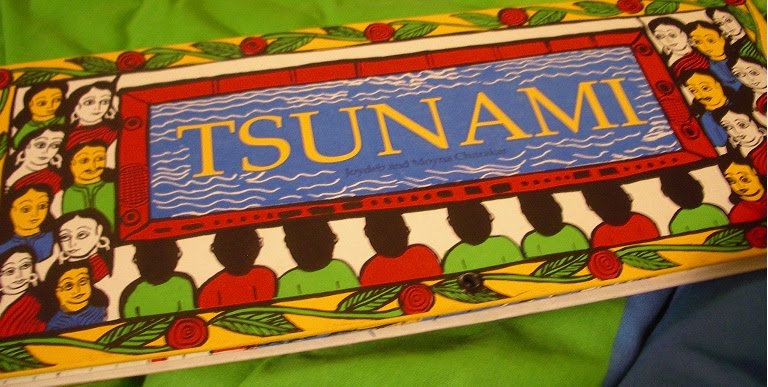
There was a small part of me thinking "Oh dear, what if I don't like the books she's representing?" but I needn't have worried. These are beautiful books, and would make brilliant presents. Let's look first at Tsunami which is a 'Patua'.
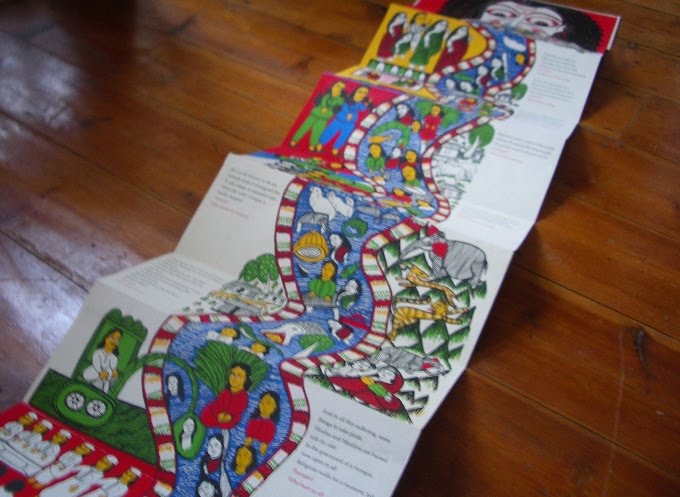
 According to the back, Patua is a 'form of narrative graphic art, comprising a series of panels, stitched together to form a scroll. It belongs to a performance tradition of Bengal when song-writer and artist went from home to home, showing pictures and singing out their stories.'
 Tsunami is the first Patua scroll to be published in book form, and unbelievably this is silkscreen printed by hand. Tara Books have a printing unit run by fair-trade standards. This is such a stunning book - playing with the boundaries of the book, perhaps - and would make a wonderful gift.
 And then there is In the Land of Punctuation by Christian Morgenstern, illustrated by Rathna Ramanathan and translated from the German by Sirish Rao. It could have been made specifically for me. It's a 1905 poem which combines a fun, whimsical story about punctuation with political undertones about segregation... didn't think that could be done, did you? What makes this version so special are the illustrations, all of which are composed of punctuation marks.

And then the captured creatures freeze
Imprisoned by parentheses
Tara Books also publish novels, and I have The To-Let House by Daisy Hasan to try later, but I wanted to draw attention to these artistic books. Any grammar-stickler you know would love In the Land of Punctuation, and anybody who appreciates Indian art would adore Tsunami. Go and see Tara Books' website for more info - I hope we hear a lot more about this company, they seem really special. And I'm not just saying that because Migs knows where I live!


 I still have a small pile of novellas to talk about (I've realised that it doesn't necessarily take any less time to write posts on short books) but I haven't yet written about Tove Jansson's Travelling Light - which has leapt, as I rather assumed it would, onto my list of favourite books this year.
 'The Summer Child' is about a disconcerting child visitor, anti-social but not malevolent: