Friday, 21 December 2012

Reginald in Russia - Saki

Most of the times that I've mentioned Saki in the past few years, it's been about his novellas.  Quite a few of us were reading The Unbearable Bassington a while ago, and earlier this year I read When William Came.  It's about time that I return to the form which introduced me to Saki, and for which Saki is best known: the blackly funny short story.  I've only read Beasts and Super-beasts in full (and love it to pieces) - Reginald in Russia filled in 1911 for A Century of Books.

I haven't actually read the earlier collection called simply Reginald, so I was prepared to be rather bemused by his adventures in Russia, but it turns out that (unlike that first collection) Reginald only appears in the first story, arguing with a Princess.  The rest of Reginald in Russia covers vast territories - including someone accidentally shooting someone else's fox, a feud between next-door neighbours, a werewolf, and a man trying to extricate a mouse from his trousers in a train carriage. It's all rather mad, and often dark, but delightfully so.

My favourite story ('The Baker's Dozen') is actually in the form of a play, where a widow and widower (once in love) meet again on a boat and decide to re-marry - but realise that between them, they now have thirteen children and stepchildren.  This, naturally, is an inauspicious start to marriage for the superstitious, and one of their tactics is attempting to palm off a child on fellow passenger, Mrs. Pally-Paget:

Mrs. P.-P.: Sorry for me? Whatever for?Maj.: Your childless hearth and all that, you know.  No little pattering feet.Mrs. P.-P.: Major!  How dare you?  I've got my little girl, I suppose you know.  Her feet can patter as well as other children's.Maj.: Only one pair of feet.Mrs. P.-P.: Certainly.  My child isn't a centipede.  Considering the way they move us about in those horrid jungle stations, without a decent bungalow to set one's foot in, I consider I've got a hearthless child, rather than a childless hearth.  Thank you for your sympathy all the same.  I daresay it was well meant.  Impertinence often is.
You see the sort of frivolous style that Saki excels at - which makes the darkest topics he approaches (including a boy being eaten by a werewolf, for example) never feel remotely scary or even unsettling.  It's all just delightful, because Saki is so brilliant at that peculiarly 1910s combination of whimsy, hyperbole, and litotes - the sort of thing which Wodehouse managed to stretch out for decades, but which thrived most in those innocent pre-war days.

He reviled and railed at fate and the general scheme of things, he pitied himself with a strong, deep pity too poignant for tears, he condemned every one with whom he had ever come in contact to endless and abnormal punishments.  In fact, he conveyed the impression that if a destroying angel had been lent to him for a week it would have had very little time for private study.
These stories are between two and six pages long each - brief, fun, easy to chuckle and turn to the next one.  Reginald in Russia isn't as good as Beast and Super-Beasts, for my money, but you don't have to take my word for it - if you click on either of those, it'll take you to Project Gutenberg where you can sample them yourself.  Perfect for a winter evening.

Thursday, 20 December 2012

Virago Secret Santa!

I've opened my first Christmas present - not illicitly, it was Opening Day for a Virago Modern Classics LibraryThing Secret Santa.  My Secret Santa was especially Secret.  I guessed who it was as soon as I saw their comment, in the thread about it all, that they knew their Santee had too many books already.  An accurate description of moi, non?  And then my Santa - who also happens to be my supervisor in the Bodleian - texted and asked when my last day was before Christmas.  The clues, they accrued!  I told Verity my suspicions, and... she threw me off the scent for a day or two.  But I was right ;)

And today I opened up a lovely Slighty Foxed edition of The Young Ardizzone by Edward Ardizzone.  I know that anything SF publish will be wonderful, so I'm excited about it - and, as I flicked through, I discovered that the first two chapters are set in East Bergholt.  It's a beautiful Suffolk village that my grandparents lived in for about forty years, so I know it pretty well - a lovely coincidence.


Can you tell that I'm delighted with it?  Christmas has begun!

Tuesday, 18 December 2012

On The Other Side by Mathilde Wolff-Mönckeberg

Yesterday I wrote about Monica Dickens' The Winds of Heaven, and told you that it was towards the fluffier end of the Persephone Books canon - and promised to take you to the other side of their spectrum today.  Well, here it is - one of Persephone's non-fiction titles, On The Other Side: Letters to My Children From Germany 1940-1946 by Mathilde Wolff-Mönckeberg, translated by her daughter Ruth Evans, and first published in 1979. 


On The Other Side is effectively Mathilde's diary, framed through letters to her children in Britain (although she never sent them), and documents what life was like in Germany during the Second World War.  Despite having read a lot about the British Home Front, the German equivalent is a perspective I have never read firsthand.  It helps that Mathilde is a delightful person, easy to empathise with - what other response would we have to someone who would say this?
Life would have no purpose at all if there weren't books and human beings on loves, whose fate one worries about day and night.
This is going to be one of those 'reviews' which are, in fact, mostly quotations from the book - because the excerpts I've selected give such a comprehensive overview of the diary that it would be a waste of time for me to try and paraphrase them. 

Rather naively, I hadn't really realised that people like Mathilde existed in wartime Germany.  I thought the German public would have been divided into those who supported Nazism, those who were apathetic, and those who lied to so much by Nazi propaganda that, though not sympathetic to those views, had no way of knowing what was going on.  But Mathilde shows that there were many exceptions:
Practically everyone knows that all that bluff and rubbish printed in the newspapers and blazoned out on the wireless is hollow nonsense, and when big speeches are made nobody listens any more.
Indeed, the account she gives of the appalling public life of Jewish Germans could scarcely be bettered by a textbook in its fullness, nor its empathy
Perhaps you cannot imagine what life is like for Jews.  Their ration cards are printed on the outside with a large red J, so that everybody knows at one that they are non-Aryan.  All women have to add the name Sarah to their first names, the men Israel.  They never get special rations, such as coffee, tea or chocolate, nor do they received clothing coupons.  After 7.30 at night they are not allowed out into the street; their radios and telephones have been removed.  Practically every shop and restaurant has a notice saying 'Jews are not wanted here.'  It is so vile and mean that I can only blush with embarrassment while I write this.  But you and your children must know of this, that things like this are possible in Germany under our present regime.  You will hardly credit all this, or the fact that we others have stood by and said nothing.  And there are much, much worse things.  Many people have committed suicide because they could not bear this indignity.  Then, like vultures and hyenas, they [the Nazis] rush in and grab the belongings of the dead; honest names are smeared with filth, and decent Germans have been driven to emigrate by the thousand.
When reading about the war from the perspective of a British person (or, I daresay, the French, Belgian etc. - I haven't read their accounts) there is much pain and anguish, but little internal conflict.  Love of country and hatred of the enemy can be expressed in a single breath, without contradiction.  While individuals may question the point of war as a concept, or the political manoeuvres of those in power, this couldn't compare to the conflict Mathilde experienced with love of country and hatred of Hitler.
But however much we strain with every nerve of our beings towards the downfall of our government, we still mourn most deeply the fate of our poor Germany.  It is as if the final bomb hit our very soul, killing the last vestige of joy and, hope.  Our beautiful and proud Germany has been crushed, ground into the earth and smashed into ruins, while millions sacrificed their lives and all our lovely towns and art treasures were destroyed.  And all this because of one man who had a lunatic vision of being 'chosen by God'.  May he and his followers be caught in just retribution.
However engaging and thought-provoking On The Other Side was for Mathilde's accounts of the war, the actual events were very similar to those in Britain - shortages, bombings, fear for loved ones.  It is certainly all moving, but it has become familiar ground in fiction and non-fiction.  The part I found most fascinating concerned Mathilde's experiences after the war was over; it was, again, something I had never read about from a German's perspective.
6 May 1945: It is Sunday and I almost hesitate to put pen to paper.  Too much has happened in the few days since last I wrote.  The whole world has changed and part of the crushing nightmare that oppressed us for so long has been lifted during these five days.  I have listened quite openly to an American and to a British radio station, no longer threatened with the death sentence for this.  I can go along the road and proclaim loudly, "Adolf Hitler, the most evil criminal in the world," and nobody will tell me to shut up.  Can you imagine that?  And can you picture our Andreasstrasse full of English trucks and private cars; on the pavements and in the front gardens a milling crowd of English soldiers - and it is a Welsh regiment, Ruth dear.  They serenely patrol the district: one is sitting in the middle of the road playing with a dog, another one is playing a recorder on a balcony; a couple tumble in and out of the house, for downstairs a captain has moved into the bottom flat.  What a lot of coming and going!
Although Mathilde and her husband welcomed the end of the war, and were very grateful for being in the British-controlled part of Germany (apparently other areas, particularly that under the rule of Russia, suffered greatly), the British army were, probably understandably, reluctant at first to sympathise with the German public. This was perhaps the most moving passage in the book:
He [her husband] was so passionately devoted to Great Britain and all it stood for.  Now he is disillusioned by the limitless arrogance and the dishonesty with which they treat us, proclaiming to the whole world that only Germany could have sunk so low in such abysmal cruelty and bestiality, that they themselves are pure and beyond reproach.  And who destroyed our beautiful cities, regardless of human life, of women, children or old people?  Who poured down poisonous phosphorous during the terror raids on unfortunate fugitives, driving them like living torches into the rivers?  Who dive-bombed harmless peasants, women and children, in low-level attacks, and machine-gunned the defenceless population?  Who was it, I ask you?  We are all the same, all equally guilty, and if my entire being was not straining towards a re-union with you, life would be nothing but torture and abhorrence.
As I promised at the start, I have mostly quoted from the book, rather than giving my own views.  It's one of those books which I believe is too important to have me weigh in on it.  I couldn't say that I loved Mathilde's voice as much as I love Nella Last's, but they are books which ought to be read alongside each other.  On The Other Side couldn't be much further from The Winds of Heaven, but both exemplify what makes Persephone Books wonderful - books which enrich the reading life, whether through delightful fiction or thought-provoking non-fiction.


Monday, 17 December 2012

The Winds of Heaven - Monica Dickens

Firstly, just thought I'd let you know that I'm back in the blogosphere (after two or three days of not reading much) and have replied to all recent comments, including all the wonderful and interesting comments on the On Commenting post.

Having recently got all excited about Persephone publishing their 100th title, I decided to check my unread Persephones against my A Century of Books list, and see how many blank spaces could be filled.  I have loved doing A Century of Books, but there's no denying that some of those blank spaces are frustratingly elusive.  However, this cross-referencing did fill up two gaps - which happened to cover the whole cross-section of Persephone's ethos.  Today's book is at the light, frothy end of the scale - the book I'll review tomorrow is serious and important.  I'm very glad to have read both.


My parents gave me The Winds of Heaven (1955) for my birthday a year or two ago, and it's been on my large pile of books I'm looking forward to reading - especially since I am already a huge fan of Monica Dickens' semi-autobiographical, very hilarious One Pair of Hands and One Pair of Feet.  But haven't yet, somehow, read Mariana.  Anyway, The Winds of Heaven is very different from those - gone is the humour, gone is the absurdity, and present instead is one widower's lonely, awkward life, bustled from pillar to post (those pillars and posts being represented by three rather selfish daughters.)

Lest we be in any doubt that those heavenly winds of the title be metaphorical, the opening paragraph is this:
When the winds of Heaven blow, men are inclined to throw back their heads like horses, and stride ruggedly into the gusts, pretending to be much healthier than they really are; but women tend to creep about, shrunk into their clothes, and clutching miserably at their hats and hair.
Louise Bickford is certainly of the creep-about variety.  She is recently a widow, left with enormous debts by an unscrupulous and selfish husband, and must spend her days living with one or other of her three daughters, on rotation.  In this novel, Monica Dickens draws her characters with broad strokes.  Having recently read V.S. Pritchett's complex and brilliant delineation of his father, it was even clearer that Louise's husband Dudley is essentially a cartoon villain.  Louise is downtrodden by him, and throughout the novel he looms in her memories like a bogeyman, apparently unkind and cruel from their honeymoon onwards.  Indeed, nobody would read The Winds of Heaven for its range of subtle character portraits - every marriage in the novel has at least one 'bad'un', and sometimes two.  On the flipside, some characters are just hopelessly nice.  Here are the various daughters and families:

1.) Miriam - sharp, pre-occupied, but not cruel.  Husband Arthur - cross, irascibile.  Daughter Ellen - sensitive, withdrawn, kind.  Other children Simon and Judy - young, excitable.

2.) Eva - bohemian.  Lover David - unreliable.

3.) Anne - lazy.  Husband Frank - adorable.

I'm being a little unkind to Monica Dickens, and I should point out that none of this prevented me enjoying The Winds of Heaven to the utmost.  It just isn't a finely-drawn, perceptive novel - it's light and broad and completely, wonderfully entertaining.  It reminded me a great deal of Richmal Crompton's novels, which I love but which (I now recognise) are far from great art.  Indeed, the relative staying with various families is a plot Crompton uses more than once, and to great effect in Matty and the Dearingroydes.

Having called this novel entertaining, I should add that its themes are often sombre.  Chief amongst these is Louise's situation - being loved but unwanted by her family, an awkward imposition wherever she goes.  In the hands of Elizabeth Taylor this would be a subtly crafted, very moving story - in the hands of Monica Dickens, it is moving but never heartbreaking.  Serious themes do not a serious novel make.  Indeed, the novel is still more entertaining than it is cautioning or saddening.  In fact, I'm trying to work out why it was so fun to read, when there is almost no comedy in it, and the events are all rather melancholy - from miserable affairs to accidents with farm machinery.  I think it's the same experience one has when watching a soap opera - the events are so over the top, and the characters embodying individual traits (Anne might as well just be a sign saying Selfish and Lazy) rather than complex personalities, that it's impossible to feel distraught for them, and instead you can settle down to guiltless enjoyment of the spectacle.

All of which sounds like I'm damning Monica Dickens with faint praise - but I have admiration for authors who can create an action-packed, page-turning novel, with underlying seriousness, and still produce a credible narrative.  Dickens' writing is never poor, and Louise herself is rather a well-drawn character - just one surrounded by characters who aren't particularly.  And which of us lives on Elizabeth Taylor alone?  It is no mean feat to produce a loveable, engaging novel.  It's the light end of the Persephone scale, but it's perfect for a winter evening when you want something relaxing and enjoyable, with just the right amount of thought-provoking paragraphs laced into the mix.  Thinking about it, The Winds of Heaven is the literary equivalent of The Archers... and that, my parents would assure me, can be no bad thing.


Saturday, 15 December 2012

A Quick Note

There's me, making a stand on being active in the blogosphere - and I go and disappear for a while.  I'm afraid I'll be ducking under the radar until Monday, and then I'll be back with pizzazz - replying to all your wonderful comments etc.  Family time at the moment - including our village sketch show, where I played newsreader Donald McTrevor (with a sort of Yorkshire accent, for some reason.)  More anon.


Thursday, 13 December 2012

Thank you!

(Firstly, apologies if my review of Love at Second Sight, see below, appears twice in Google Reader etc. - I published it early by mistake, then deleted and republished!)

I've found the discussion on yesterday's post so, so interesting and helpful - thank you so much for joining in, if you did.  I hope it was clear that my post was talking to myself, as much as anyone, and that I was trying to address a more general point about the blogosphere, rather than just my blog.  I'm glad so many of us are going to make the same commenting resolution for 2013!  (Although this particular little post can probably be ignored, commentingwise ;) )

Just an update - I recently reinstated the word verification (having had it off for ages) because I was sick of getting dozens of spam comments everyday.  Blogger works out that they're spam, and they don't appear here, but they fill up my inbox.  However, after feedback yesterday, I've removed the word verification - as that does seem to make quite a difference to people's experience of commenting.

Happy Thursday!  I'll be spending much of my day on a train - but it'll be worth it, cos I'm going hoooome for Chriiiiistmas!  I'll reply to all of your comments (another thing which seems to make a difference, and which is a heck of a lot more fun for me than deleting spam emails!) as soon as I can.

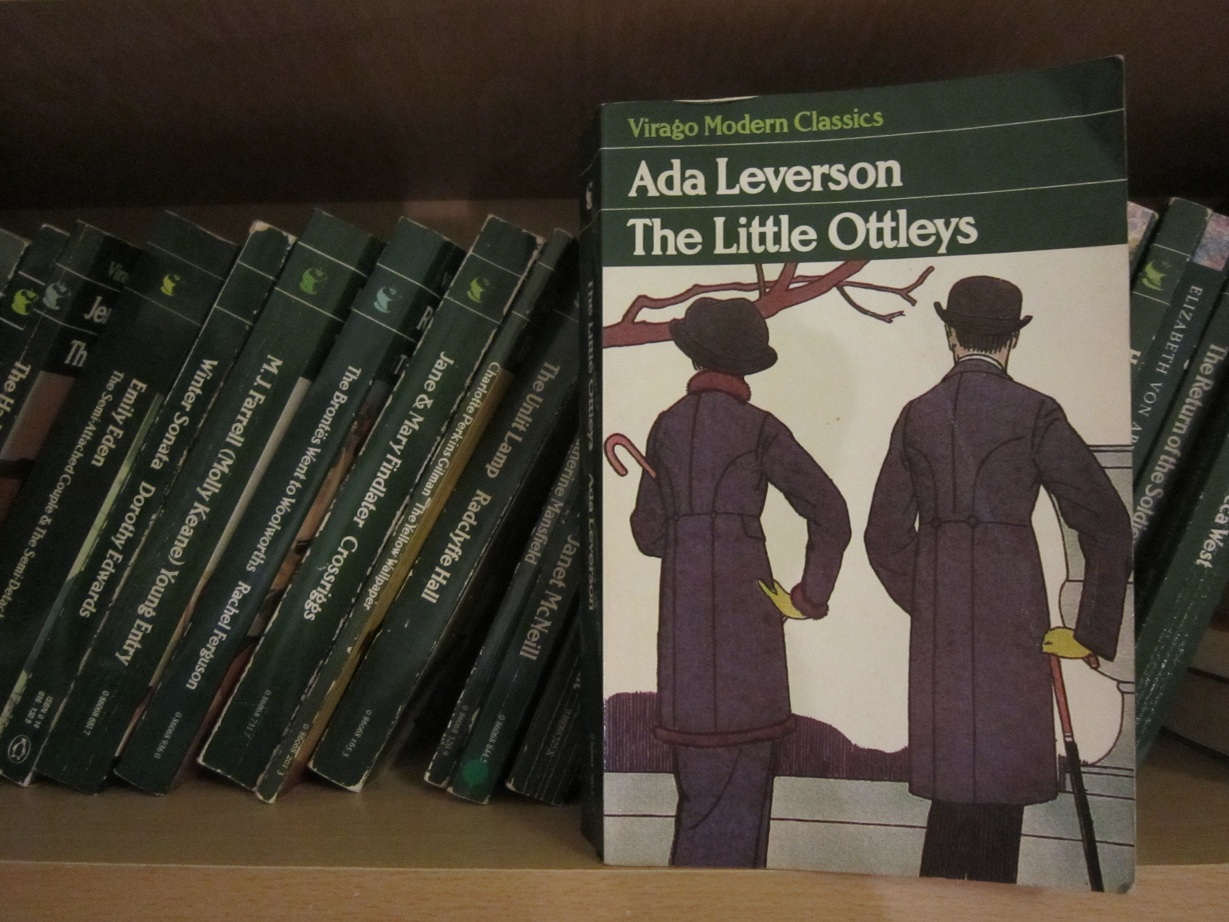
Love at Second Sight by Ada Leverson


Whilst rooting around for a 1916 title for A Century of Books (you should have seen me, scrabbling through my books, opening covers, reading publication details, reshelving huffily) I stumbled upon Love At Second Sight by Ada Leverson.  It's the third book in The Little Ottleys, of which I have previously read the first - Love's Shadow - which was rather brilliant.  This is the only time A Century of Books has really rather compromised my reading plans - in that I skipped past the second title in the trilogy (Tenterhooks) straight to the third.  But someone had spoken on The Little Ottleys at a recent conference, and given away the plot, so it wasn't as calamitous as it could have been.

Look away if you don't want to know what happened in the first two novels... but they've (to be very brief) set up the fairly loveless marriage of Edith and Bruce; Edith falls in love with Aylmer Ross, but will not leave her husband, even when he asks for a divorce himself (having run off with another woman); he comes back to her, and everything settles down into what it had been before - which is to say, an amusing, charming, patient woman, and an exasperating man.  Bruce is best summed up by this wonderful quotation from Love's Shadow: "He often wrote letters beginning "Sir, I feel it my duty," to people on subjects that were no earthly concern of his."  As for the lovely Edith, I'll hand over to Leverson to describe her.  An author should show and not tell, as a rule, but all these qualities in Edith have been exemplified in previous books, so it is forgiveable that Leverson wants to let us know what a wonder she is, so that we can get on with the show.
She was a slim, fair, pretty woman, with more vividness and character than usually goes with her type.  Like the boy, she had long-lashed grey eyes, and blonde-cendre hair: her mouth and chin were of the Burne-Jones order, and her charm, which was great but unintentional, and generally unconscious, appealed partly to the senses and partly to the intellect.  She was essentially not one of those women who irritate all their own sex by their power (and still more by their fixed determination) to attract men; she was really and unusually indifferent to general admiration.  Still, that she was not a cold woman, not incapable of passionate feeling, was obvious to any physiognomist; the fully curved lips showed her generous and pleasure-loving temperament, while the softly glancing, intelligent, smiling eyes spoke fastidiousness and discrimination.  Her voice was low and soft, with a vibrating sound in it, and she laughed often and easily, being very ready to see and enjoy the amusing side of life.  But observation and emotion alike were instinctively veiled by a quiet, reposeful manner, so that she made herself further popular by appearing retiring.  Edith Ottley might so easily have been the centre of any group, and yet - she was not!  Women were grateful to her, and in return admitted that she was pretty, unaffected and charming.

Love At Second Sight opens with a scream.  The Ottleys' son Archie has, it seemed, used Madame Frabelle's mandolin as a cricket bat, and she is not best pleased.  And who might Madame Frabelle be, you ask?  The Ottleys want to ask much the same thing.  Their delightfully forgetful and absent-minded friend Lady Conroy introduced them (although later denied ever having heard of her, and in fact asks for an introduction herself) - and Madame Frabelle arrives for a visit.  Which has lengthened itself into many, many weeks.  She is charming, a great listener, given to understanding people - noticing their subtlest of thoughts, predicting their actions, and invariably being wrong about everything.
Indeed Edith did sincerely regard her opinion as very valuable.  She found her so invariably wrong that she was quite a useful guide. She was never quite sure of her own judgement until Madame Frabelle had contradicted it.
Madame Frabelle is determined that Edith is in love with Mr. Mitchell, another of the Ottleys acquaintances.  What neither Madame Frabelle nor Bruce notice is that Edith is in love - with Aylmer, who has returned from fighting in France with a broken leg.  Edith has to face a quandary - whether or not to leave her husband...

As I say, I haven't read Tenterhooks, where a similar story takes place, so I can only contrast this with the first book in the trilogy.  In that (again, c.f. my review here), we see a marriage which is irksome and unequal, but in a comic fashion.  All the will-they-won't-they plot concerns a multitude of other characters, none of whom have stayed in my mind, and the central Ottley marriage is stable, if awful.  Bruce's absurd lack of self-awareness is hilarious, and his terribleness as a husband is darkly humorous - in Love At Second Sight, more is at stake, and more than a punchline is likely to come out of this incompatible couple.

Which is not to say that the novel isn't funny.  It is very amusing, especially when Lady Conroy wanders onto the scene.  Ada Leverson was friends with Oscar Wilde, and his influence is apparent - if anything, rather more so than in Love's Shadow, because she turns to the epigram rather more frequently in Love At Second Sight - par example, 'she was a woman who was never surprised at anything except the obvious and the inevitable'.  Sometimes this clash of serious storyline and comic prose was a little disconcerting - I thought the balance worked better in Love's Shadow - but  this is still a wonderful little book.

Of course, what you should do is get the trilogy and read them in order!  I'll read Tenterhooks one day, and then everything will fall into place properly...